MONITORING & MANAGEMENT

This site is intended for US audiences
Gaucher disease is a rare genetic disorder. It is caused when waste materials are not broken down. Instead, they build up slowly in different organs. Over time, this causes damage that can lead to a range of symptoms.
Learn more about type 1 Gaucher disease by reading the Disease Overview.
Type 1 Gaucher disease affects both females and males equally. There are an estimated 6,000 affected individuals in the United States. People of all ethnicities can be affected but the number of people with type 1 Gaucher disease is higher in Ashkenazi Jewish people.
Learn more about the Prevalence of type 1 Gaucher disease.
In people without Gaucher disease, cells in the body “swallow” waste. The waste is broken down in a small part called a lysosome. People with Gaucher disease do not have enough of an enzyme to break down the waste. The waste is stored and builds up in the cell.
Learn more about How It Works .
Gaucher disease is hereditary, which means that it is passed down from parents to children through their genes. Gaucher disease is caused by changes (mutations) in the gene that makes the enzyme glucocerebrosidase, which breaks down fatty substances.
Learn more about the Inheritance and Genetics of type 1 Gaucher disease.
People with Gaucher disease can start to experience symptoms from any age, including in childhood or in late adulthood. Some of the main signs and symptoms are tiredness, bruising and bleeding, and a swollen midsection.
Learn more about the Signs & Symptoms of type 1 Gaucher disease.
If you suspect you or a loved one could have type 1 Gaucher disease, talk to your doctor. Type 1 Gaucher disease is diagnosed with the following:
Learn more about the Diagnosis of type 1 Gaucher disease.
Enzyme testing and genetic testing are used to diagnose type 1 Gaucher disease:
Learn more about the Testing for type 1 Gaucher disease.
Regular monitoring is important as type 1 Gaucher disease can worsen over time, even though a person might feel well and not notice any changes. Most people with type 1 Gaucher disease have check-ups every 3 to 12 months. However, type 1 Gaucher disease is different for everyone so your doctor will advise you on how often you should come in.
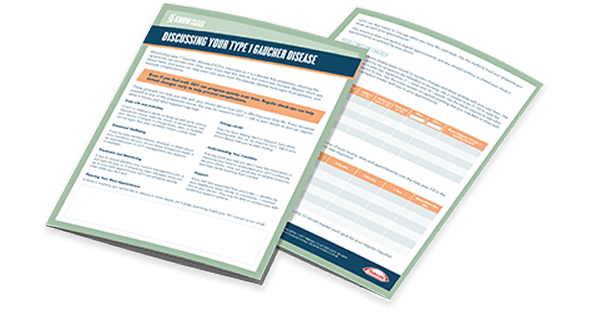
Learn more about the regular Monitoring for type 1 Gaucher disease. Download our toolkit
The type of doctor depends on the symptoms a person with type 1 Gaucher disease has. The care team may include a Gaucher specialist, a hematologist, and a geneticist.
Learn more about the Management of type 1 Gaucher disease.
As well as treatment for type 1 Gaucher disease, there are supportive therapies. This care will be specific to you and the symptoms you have. This could include supportive therapy for bone disease or pain.
Learn more about the Supportive Therapies for type 1 Gaucher disease.
It is important to remember that you are not alone. Other people are living with type 1 Gaucher disease.
Read their Patient Stories and advice they would give to others.
Downloadable materials and additional sources of support are available. You can also ask your doctor about local support for you
Find Resources to support you.
If you have type 1 Gaucher disease, know that it can worsen over time – even if you are well. Talk to your doctor about any concerns or questions you may have. Attend all of your check-ups for tests and scans.